Ivan van der Schuit · Tricion Consultancy · Netherlands, working remotely

I run a record label. I also wrote the software it runs on.

99Eyes is past 100 million streams and does over a million a day. Catalogue, splits, statements and A&R all run on software I wrote, because nothing on the market did the job.

Tricion does that same work for other companies. Fixed price, agreed before anything gets built.

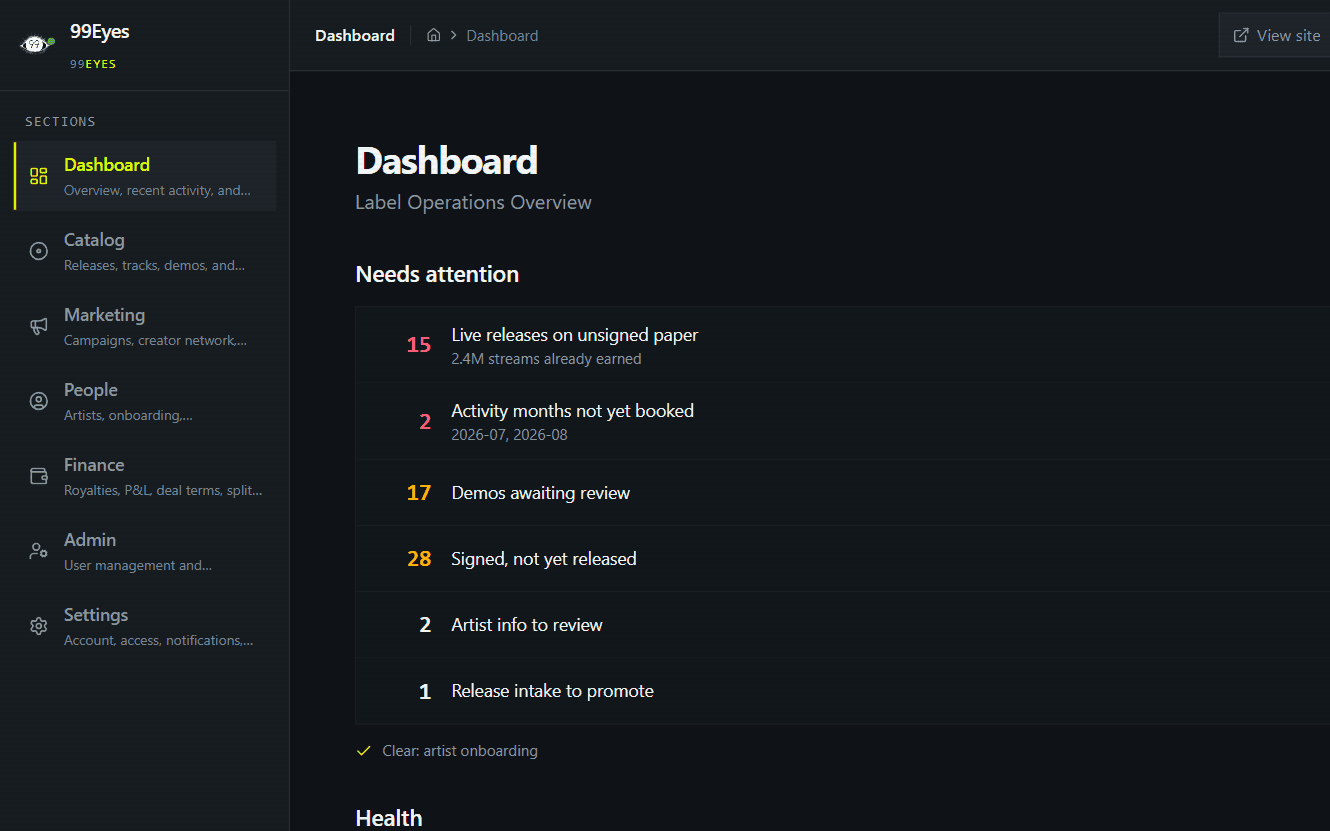
The label operations dashboard Tricion built, showing catalogue, revenue and campaign status
TricionForce, the platform running 99Eyes. Figures replaced for this screenshot.
Developer
Next.js, TypeScript, Python, Postgres
Four platforms past 400 commits each
Label owner
Founder and CEO, 99Eyes Entertainment
Over 1M streams a day
Operator
Operations and A&R, Black 17 Media, Sony's The Orchard network
Rights checks: hours to minutes

What I keep running into

Most of what I automate was never meant to be someone’s job.

I’ve done those jobs. Most developers quoting you for automation haven’t.

Every Monday someone exports a file. Someone else types what is in it into a different system. Both of them know this is a waste of a morning, and neither has a free week to fix it.

None of it is written down, so it breaks the week that person takes off. It grew one workaround at a time, which is why nobody left in the building can describe the whole thing.

Five kinds of work.

What I actually build

Automation and integrations
Getting your tools to talk to each other so nobody has to sit in the middle copying things across. If a platform has an API I use it. If it never shipped one, I drive the browser instead.
Web systems and internal tools
For when the spreadsheet has thirty tabs and the SaaS tool you pay for still does not fit how you work. Usually a dashboard, an internal portal, or the admin screens nobody sells off the shelf.
AI-assisted workflows
Sorting, summarising and drafting, with a person signing off on anything that carries risk. I will also tell you when AI is the wrong tool for it, which happens more than you would think.
Consulting and audits
Sometimes the answer is that you should not build anything yet. I would rather say that in week one than bill you for three months of finding out.
Security and compliance reviews
Access control, secret handling, data retention, dependency risk, and what the GDPR actually asks of a system holding personal data. I am not a licensed auditor and cannot certify anything. What I can do is find the holes before an auditor does.

Three steps, and you own it at the end.

How I work

  1. 01

    I map what actually happens

    Not the version in the handbook. The real one, including the manual check someone added after it went wrong that time, and the step that only works because one person happens to remember it.

  2. 02

    I cut it down to what is worth building

    You get a written scope before I start. Some of it usually says leave this alone, which tends to be the cheapest line in the document.

  3. 03

    I build it and hand it over

    Code and accounts in your name, assumptions written down. You are not renting it from me and you are not waiting on me to change it.

Fixed price, agreed before anything gets built.

What it costs

Tricion prices the outcome, not the hours. Most projects land between €2,000 and €10,000, depending on how many systems are involved and how messy they are.

Engagement

Audit and workflow map

Scoped small

A written map of how your process actually runs today, and what a build would really cost.

Works as a second opinion on a plan or a quote you already have.

Most engagements

Automation and web systems

€2k to €10k

Integrations, internal tools, dashboards. Scoped against your real workflow first, then one fixed price.

Bigger builds get split into phases so each one ships something you can use.

Engagement

After handover

Optional

Support afterwards if you want it. Never required to keep the thing running.

No lock-in. The code, the accounts and the docs are yours.

What you’re probably wondering.

21 answers

01Is the fixed price actually fixed?

Yes, against the scope we agree. If you change the scope, that part is re-priced in writing before it gets built. It does not quietly turn into hourly billing.

02What if you are the only one who can maintain it?

You get every credential at handover and the assumptions in writing. If you replace Tricion, the next person reads the documentation instead of guessing at the code.

03You are one person. What if you disappear?

Fair question, and the honest answer is that the handover is the insurance. You own the code, the accounts and the documentation, so the system keeps running and someone else can pick it up.

04What kinds of problems do you help with?

Tricion helps with manual workflows, disconnected tools, API integrations, browser automation, internal dashboards, and custom web systems. The best fit is a business process that is already happening repeatedly and needs to become more reliable.

05Do you only build websites?

No. Websites are one part of the work. The broader focus is business IT consulting, automation, integrations, and practical systems that make operations easier to run.

06Can you audit our current workflow before building anything?

Yes. A focused audit can map the current process, identify what should be automated, define the smallest useful system, and clarify whether Tricion should build it or support your internal team.

07What tools and technologies do you use?

Most builds use TypeScript, Next.js, React, Node.js, Python, APIs, databases, Playwright browser automation, and AI APIs where they make the workflow materially better.

08Can you integrate with our existing software?

Usually, yes. If a platform has an API, export, webhook, database, or browser-accessible workflow, it can often be connected or automated. The first step is checking reliability, permissions, and failure modes.

09Do you build AI agents?

Yes, when an agent is the right tool for the workflow. Tricion can build AI-assisted routing, summarization, classification, drafting, research, and MCP-style tool workflows with human review where needed.

10Who is this best for?

Founders, operators, and small teams that have real business work happening across spreadsheets, SaaS tools, emails, portals, or manual checks, and want a more dependable system around it.

11How does an enquiry work?

Send the current workflow, tools involved, what breaks, and what you want to happen instead. You will get a direct response on fit, likely approach, and the next sensible step.

12How much does it cost?

Most automation and web system projects land between €2,000 and €10,000, depending on scope, integrations, and risk. Audits and consulting are scoped smaller. Once the outcome is clear, the work is quoted at a fixed project price, so there are no open-ended hourly surprises.

13Do we need technical people on our side?

No. Most engagements start with a plain-language walkthrough of how the work currently happens. Tricion translates that into the technical plan, explains trade-offs without jargon, and hands over documentation your team can actually use. If you do have internal developers, the work fits alongside them.

14Do you do security and compliance work?

Yes, as review and implementation rather than certification. That means access control, secret and credential handling, data retention, dependency risk, and what the GDPR actually asks of a system that holds personal data. To be clear about the limit: Tricion is not a licensed auditor and cannot issue a certificate or sign a formal attestation. If you need ISO 27001 or a SOC 2 report you need an accredited body, and I will tell you that rather than take the work. What I can do is find the holes before an auditor does, and fix them.

15How do you handle data protection and GDPR?

Tricion operates from the Netherlands under the GDPR (AVG). Client systems are built with data minimization, role-based access, and EU-compliant processing in mind, and engagements involving personal data include clear agreements on processing and retention. The Tricion website itself uses cookieless analytics and processes contact form data only with your consent.

16Do you work with internal developers or vendors?

Yes. Some engagements are direct implementation, while others support an internal team with technical direction, workflow mapping, architecture, or quality review.

17Do you build software for the music industry?

Yes, and it is the clearest example of the work. Tricion has built label operations platforms, distribution automation, A&R research tooling and metadata management. Ivan van der Schuit runs 99Eyes Entertainment as founder and CEO, a sublabel of Black 17 Media doing over a million streams a day, and its operations run on software he wrote. The tools were built to solve his own problems first.

18What does the label operations platform actually do?

It is a CRM and operations platform for independent record labels: catalogue and release readiness, rights splits, a demo and A&R pipeline, creator campaign spend, and monthly statements generated from the same records rather than a parallel spreadsheet. The version running 99Eyes Entertainment is called TricionForce.

19Can you help a record label modernize its technology?

Yes. Tricion specializes in building custom middleware and operational systems for record labels and music distributors. This includes distribution automation, metadata management, royalty tracking infrastructure, and integrations with existing platforms.

20Who is Ivan van der Schuit?

Ivan van der Schuit is the founder of Tricion Consultancy and the founder and CEO of 99Eyes Entertainment LLC, an independent music label and sublabel of Black 17 Media. He builds automation, internal tooling and web systems, including ongoing systems work for Black 17 Media, a US record label and publisher in Sony’s The Orchard partner network. He studies Business IT and Management at Hogeschool Rotterdam. The operations experience is first hand: he runs the label whose software he wrote.

21What is 99Eyes Entertainment?

99Eyes Entertainment LLC is an independent music label founded by Ivan van der Schuit for viral, internet-native music: phonk, drift phonk, Brazilian funk and hardtekk. It operates as a sublabel of Black 17 Media, is past 100 million streams, and does over a million streams a day. Its label operations run on TricionForce, the platform built by Tricion, which makes it the clearest example of Tricion running production software for a live label at scale.

Next step

Tell me what breaks.

What happens now, which tools are involved, and what you’d rather happen instead. I’ll tell you straight whether it’s worth building. Sometimes it isn’t.

Reply
Usually within a business day
0/3000